Subscribe to my author newsletter THE AMALIAD, to stay up to date on Authors!me, and get a FREE short story about Ariadne and Theseus!

Monday, June 13, 2022

Misogyny in the Myths (and Theseus)

Seven Years Ago on Facebook, I asked this question, and I feel like it summarizes my entire BRAND as Amalia Carosella:

"How much misogyny do we read back into the myths because we're expecting it to be there, or even assuming that it is the only possible interpretation? For Classical Athens, yes, there certainly was a good bit of it -- but these stories predate Classical Athens. Is it possible the Mycenaeans with their imagery of women seated upon thrones accepting offerings, their goddesses accepting gifts, their daughters through which kingdoms were inherited, might have lived differently?"

I think this is why so many mythic retellings fall short and disappoint me--because they're not interrogating this element of the retelling, usually. They're just telling the story inside the same assumed misogynistic framework from the perspective of a woman, instead. And sure, that has its place, too. But why trap yourself in that box when there is room to give these women true agency and real power, too? When there is a whole society in which people might have lived differently, during which, if they happened at all, most of the events of these myths would have taken place.

This is also part of why the current cultural fashion of reading Theseus as nothing more than a monster bothers me--because in the source material of his mythology there is a parallel thread of a hero who loved a woman and was forced to give her up at the command of the gods, who grieved that loss, and whose grief then caused him greater grief again. If he didn't coldly abandon Ariadne, and he didn't just "forget" to change the sails, but was emotionally compromised by the sacrifice the gods demanded of him as a result of a true and very real attachment to Ariadne, he is a different man, and the framing of his future relationships shifts, too. 

(And let's not forget that when this all goes down, Theseus can't be older than 18. He was still a youth, which was why he was able to go to Crete as one of the tributes at all. I don't know about you, but when I was 18, I was emotionally compromised more than I wasn't, and I hadn't just faced down a monster to save my people and only escaped with the help of a princess who should have been my enemy, only to receive a command from my gods to leave her behind--and Theseus himself is a son of Poseidon. The command of the gods, in his world, would not have been something he imagined or a sign he misunderstood.)

There is SO MUCH ROOM in that story for us to see a hero worthy of admiration, a hero who truly values women (he was raised by a single mother, fam! He brings her with him to Athens as his ADVISOR after he becomes king!), but instead we've gutted all that EXTANT nuance to make him a vainglorious self-centered, callous jerk, who uses women for his own ends and drops them. 

That is a choice WE have made in our supposedly "enlightened" and "feminist" modern age, to make him MORE misogynistic, rather than less. How many similar choices were made by people before us along those same lines, winnowing down the story to refocus it toward patriarchy and misogyny each time? 

The threads are still there though! SOMEHOW they survived thousands of years to reach us. Maybe we should think twice before we discard them, AGAIN, entirely. 

And not just when it comes to Theseus.


Ariadne on Amazon | Ariadne on Other Retailers || Tamer on Zon | Tamer on Other Retailers

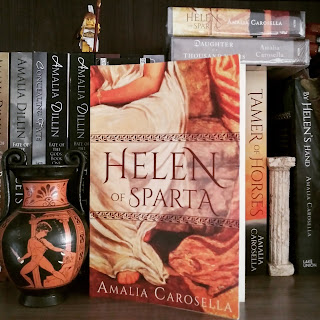
If you're looking for a different read on my favorite hero, you'll find my alternate take on Theseus and his myths in my short story retelling the events of that fateful trip to Crete, Ariadne and the Beast, as well as in my novels TAMER OF HORSES (Theseus is a secondary character, married to the Amazon Antiope--who you will ALSO love) and HELEN OF SPARTA (in which he is unquestionably our hero in the truest sense of the word!) 


Tamer of Horses Helen of Sparta By Helen's Hand Daughter of a Thousand Years A Sea of Sorrow: A Novel of Odysseus
Amazon | Barnes&Noble | IndieBound

Thursday, March 10, 2022

Everyone Hates Theseus (Except Me)

I joke a lot about how I am the only person left who doesn't hate Theseus but--fam, it is WILD to me, every time I slam up against that wall again. So this is your warning: I am UNAPOLOGETICALLY biased toward Theseus, and this post is just one gut-driven facet of my defense!

Athenians-being-Delivered-to-the-Minotaur-in-the-Cretan-Labyrinth by G.Moreau
Gustave Moreau, Athenians Being Delivered to the Minotaur, Public domain, via Wikimedia Commons

Heracles had a choice, according to his myths, and chose glory. Achilles had a choice, according to his myths, and chose glory. Theseus had a choice, according to his myths, and chose glory. But today, culturally, Theseus (and to a lesser extent Achilles) gets the most heat for making that choice (and is reduced to a self-serving gloryhound only)--even though his choices generally better the circumstances for the people he ultimately wants to serve/lead (Athens). 

Heracles's labors, in contrast, are most often framed inside his mythology as a means by which he ultimately serves himself--to redeem himself for the murder of his wife and children (or his children and nephews, or all three). He doesn't really have much of a choice about taking these labors on, because it's either DO THE THINGS, DIE, or BE FOREVER OUTCAST. And while those feats are impressive and worthy of awe, few of them are really improving things for anyone else--they're just increasing his fame. His initial choice to pursue glory despite his affliction of madness by Hera starts a war for Thebes (by another act of his madness), and then he is elevated for winning that same war he started, then he murders his family in another fit of madness and is forced to flee and seek atonement/purification through his labors. Is that really so much more sympathetic?

Theseus didn't HAVE to take the Isthmus road and clear it of the monsters who preyed upon travelers (the labors which are generally considered to be comparable to Heracles'). One could argue that he HAD to volunteer himself to go to Crete if he wanted legitimacy as a prince (and later king) of Athens, to prove himself to a people who did not know him, but it doesn't only serve him to do so--it serves as an attempt to liberate Athens from the oppression of Crete, which imho, served as a metaphor/explanation for the fall of what we today refer to as Minoan Civilization and the rise of what we consider Mycenaean/mainland Greek influence and dominance in that period. 

BUT. It's curious to me, that we have culturally chosen to elevate the hero who is most famously acting for himself (Heracles) while dismissing and undermining the heroes who took action against powerful forces seeking to subjugate or harm others. The way we have maligned Achilles also, for example, the only hero who speaks out against a leadership that is wasting the lives of its army for the ego and selfishness of one man to fight a war that should never have been fought and reduced him to someone who selfishly sulks in his tent while others die for the Achaean cause--when it was on behalf of the Achaeans dying of plague he spoke out to begin with! It's not hard to see who that narrative might serve in the modern age. 

Theseus is hated (it seems to me) primarily because he abandons or forgets Ariadne on the beach, and everything else he did (saving Athens from having to send its children to die in Crete in perpetuity, making the Isthmus road--the land connection between the Peloponnese and the rest of Greece--safe for travelers) has become meaningless in the wake of that one act, transforming the entire shape of his character in retellings of his myths--even though Ariadne ends up the consort of a god, elevated far beyond what she might have found as Theseus's wife and Queen of Athens. But how many women does Heracles take in the course of his adventures and pass off to other men or leave behind pregnant without looking back? Why don't we ever get upset on their behalf and condemn Heracles to the same degree? Why is it only Theseus who gets all that heat? 

This is not to say that there are not valid critiques of these heroes, all of them. That we should not look at Heracles and Theseus and Achilles and their actions from a modern perspective and condemn what is obviously garbage behavior. None of them really hold up well as romantic literary heroes without some massaging of their stories (though I would argue that we hold up people just as flawed and problematic and selfish and even monstrous--or more monstrous even--as heroes today in and out of literature. We have only to look at the praise heaped upon authoritarian dictators, upon billionaires making bank by strip-mining the planet and exploiting labor, at famous figures who abuse their loved ones or those they employ, to see that we are not at all immune to that same impulse in the present.) But isn't it also just as legitimate to retell their stories in ways that allow us to reconnect with these heroes of the past? To make of these figures, these stories, someone worthy of the fame they'll likely never shake? 

If they are only fiction, then maybe it makes no difference either way, except to give ourselves an aspirational ideal if we want it. But if they are and were bridges between the mortal and the divine, bringing them into the present in a way that makes them worthy (without dismissing utterly the context from which they sprang), that helps us find our own (modern) ways to the gods, feels not only important, but somehow necessary.

Leaving that aside for the moment, the most important thing I'm saying here is this: 
If we are going to forgive Heracles for being a drunken brawling brute, for literal murder and the waging of city-destroying wars, for taking lover after lover with no shortage of dubiousness on the issue of consent to say nothing of the power dynamics in play, can't we not also, maybe, just CONSIDER not ALWAYS hating on Theseus, when most of his core mythology is just him trying (not always successfully or without consequence to others) to make things better?

And if you want to read my take, you can start with HELEN OF SPARTA or TAMER OF HORSES!


Monday, January 24, 2022

Bronze Age Greece Hist Fic Reading Order

It occurred to me this past weekend that you all might benefit from a reading order reference for the books all set in the shared world of HELEN OF SPARTA, in Bronze Age Greece, so I'm here to make it happen today!

These books, so far, except for SON OF ZEUS, all take place between the conception of Theseus and Odysseus's return home to Ithaca. That... probably will change, because I'm working on a Heracles book as we speak, and I have a larger Aethra project in the works as well! Something to look forward to, I suppose, and of course I will update this list when/if those titles are completed and released.

As things stand right now, if you'd like to read these works in chronological order inside the Bronze Age, here's where to start:


1) The Lion of Troezen (Novelette--launching on Patreon, January 2023) 
More than 40 years before Helen of Sparta, this novelette retells the myth of Theseus's conception, focusing on Aethra's extremely intimate relationship with Poseidon, and how that relationship alters the course of her life.
 
2) Ariadne and the Beast: A Short Story 
A little more than 25 years before Helen of Sparta. I guesstimate Theseus is in his late teens during the events of this story!
 
3) Tamer of Horses
~20 years before Helen of Sparta. Theseus and Pirithous are both kings of their respective domains, but still learning what that means.
 
4) Helen of Sparta
Theseus and Pirithous are both in their 40s and Heracles is older, still. 
 
5) By Helen's Hand 
Picks up right where Helen of Sparta leaves off. Pirithous's son by Hippodamia, Polypoetes, is of age to take over for his father as king of the Lapiths.
 
5a) A Broken Horse 
This novel is written but not yet published--I'm looking for an agent!--and follows both Paris and Polypoetes as they navigate the Trojan War.
 
6) The Siren's Song/A Sea of Sorrow
Takes place after the close of the Trojan War, as a retelling of The Odyssey. A Sea of Sorrow is in continuity with A Song of War, History 360's retelling of The Iliad, but my revised author's cut edition of The Siren's Song novella does exist within the same world as Helen of Sparta.
 
7) Son of Zeus
~3000 years or so after Helen of Sparta, this novel takes place in our modern world, and Pirithous is still in his 40s after being trapped in the chair of forgetfulness for millennia.

 All these titles, with the exception of Helen of Sparta and By Helen's Hand, were written to stand alone. You don't need to have read Tamer of Horses to enjoy Son of Zeus (I wrote Son of Zeus immediately after I finished writing Helen of Sparta, actually, before I had even written Tamer of Horses or By Helen's Hand.) And you don't need to read Ariadne to enjoy Helen of Sparta, though Theseus appears in both. 

You probably DO want to have read Helen of Sparta before you pick up By Helen's Hand, though, as they were written as a duology of Helen's life leading up to the Trojan War. And if you did happen to read Tamer of Horses before or after Helen of Sparta, it might enrich the experience of both books! If I've done my job right, you shouldn't need to have read either of Helen's books before A Broken Horse, either, when/if that makes it out into the wider world. Do I think you'll enjoy it more if you have? Yeah, of course. And even more again if you've read Tamer of Horses as well, since that's the story of Polypoetes's parents. But it shouldn't be a necessity. 

Consider them all just--companion novels, that allow you to travel a little deeper into the world and the stories of the characters you've met, either in reading Helen of Sparta, or in your own exploration of the myths themselves.

Tamer of Horses, Son of Zeus, and Ariadne and the Beast are all available in wide release through the digital retailer of your choice. Tamer of Horses and Son of Zeus are also both available in paperback for your physical reading pleasure--you should be able to order them from pretty much anywhere. (Here's a bookshop.org link to prove it! Alas, the Son of Zeus hardcover is Amazon Exclusive.) 

Ah! and before you go, The Siren's Song is going wide this week! Look for it in your library apps and available from non-amazon vendors at this link very soon!!!


Thursday, March 11, 2021

Son of Zeus: The Modern Adventures of Pirithous

It's been pretty quiet over here because--well, social media and also pandemic plague times, and my Amalia Carosella stuff got a little lost in the excitement of launching a third entire pen name last year, Amalia Theresa, for sexy romcom style contemporary romances.  

But it's 2021 now, and for you, that means: MORE PIRITHOUS!

Goodreads


If you've been following me on social media, you might already know that SON OF ZEUS was released exclusively to Patreon Patrons in a serialized format beginning in 2019. This summer, it's coming out in wide release for everyone else to read in paperback or the ebook format of their choice! Which means I have a goodreads link for you in preparation, even if I haven't quiiiite settled on the exact release day yet. (Right now it's looking May-ish?)

It also means that the first two chapters are available for you to read over on patreon as a teaser, and so is the rest of the book for as little as a dollar a month, if you want to get your read on in advance! 

You'll notice, too, that this book is authored by BOTH Amalia Dillin and Amalia Carosella--that's because while Pirithous is an Amalia Carosella character--the same Pirithous you all loved in HELEN OF SPARTA and TAMER OF HORSES--the contemporary setting and his adventures as a fish out of water in upstate New York felt a little bit like an Amalia Dillin story at the same time (in fact, it was written well before Amalia Carosella was even invented!) 

I think this book will have a lot of appeal to BOTH audiences, and I wanted to make sure readers of Amalia Dillin and Amalia Carosella could find it!

A NOTE FOR PATREON PATRON READERS: The Wide Release edition of SON OF ZEUS will have some small edits and expansions--nothing that makes a big difference to the story and mostly just places where the wording felt like it could be stronger or I needed another line to clarify Thalia's thoughts or Pirithous's intentions.

BUT WAIT, THERE'S MORE!

In celebration of SON OF ZEUS's much belated release, TAMER OF HORSES is also going wide! No longer will you only be able to enjoy Pirithous's wedding to Hippodamia and the war with the centaurs that follows on kindle alone (and also everywhere in paperback already) but very shortly, you'll be able to grab it from apple books, for nook, kobo, and request the digital edition for your local library! 

I hit publish just this morning and will update this post and Tamer's home page with the new links once they start going live.

Taking TAMER OF HORSES wide has always been kind of a huge, terrifying leap for me with HELEN OF SPARTA and BY HELEN'S HAND as Amazon exclusive titles, but with SON OF ZEUS coming--it finally makes business sense to share this story with a potentially wider retail ecosystem, too. 

I hope you'll all enjoy BOTH of Pirithous's adventures now that they're going to be available outside of the kindle sphere!

As always, if  you've already enjoyed any of my books, do consider leaving a review wherever you bought it or like to review your reads. 


Tuesday, August 20, 2019

The Judgment of Paris and Imposition by the Gods

 After I published last night's blog post about consent as it relates to rape, and the divine, I started thinking about Paris and his Judgment. When those three goddesses appeared before him and told him it was his job to pick one--it wasn't like he could refuse the task. Not without risking offending them, and there was no way that FULFILLING the task didn't risk offense of at least two of them, too. It was an entirely no-win situation for him.

And he had no real choice. He had to do as the gods asked. He couldn't say no without endangering himself. And not just because it might offend the three goddesses, but since ZEUS had commanded it, Paris risked offending HIM, too.

Angelica Kauffman - El juicio de Paris
Angelica Kauffman's The Judgment of Paris via Wiki Commons

Then again, if we're to believe that Zeus basically organized and orchestrated the entirety of the events that would lead to the Trojan War (as some sources allege), then Zeus had to have known exactly what he was doing, sending those goddesses to Paris to begin with--including the outcome of Paris's choice.

Paris was set-up to be the fall-guy for the gods.

All that disdain with which his character is treated basically plays right into their hands. Like a magician's flash of distraction, while he springs the trapdoor in a disappearing act. We have spent three thousand years blaming the victims of Zeus's machinations--between Paris, Helen, and Achilles (the only person who seemed to wake up and recognize the injustice of the whole situation, and we act like he's a sulky teenager and scorn him.)

The idea of Fate and everything it implies is totally WILD (and so is the idea of a omniscient, omnipotent power, because one can't really exist without the other.) And I'll grant you, it's hard to wrap our minds around it all as mortals living a finite existence. Personal responsibility for one's actions is also a thing that matters, a means by which we hold members of the community accountable in the present--In The Present.

But when we're engaging with these myths, we aren't only engaging with the present. We're engaging, also, with the past. And a past that played by different rules than we do, now, in relation to the divine and the gods, the tension between the mortal and the immortal. Acknowledging that the mortals involved LACKED a certain amount of choice, recognizing their limitations, and the role and power of the gods over their lives seems critical to me.

And this is part of why I dislike retellings that excise the gods from the story. Because removing them unravels the entire tapestry when peoples lives and fortunes are dependent upon their engagement and interference.

Without the gods, Paris is a coward who fled the field when facing off against Menelaus in a challenge he couldn't win.

With the gods, knowing he isn't likely to win the challenge, Paris faces Menelaus anyway, and it's ONLY because Aphrodite whisks him from the field that he lives.

(Sidenote: when Hector breaks and runs from Achilles, we give him a pass and treat him still as a hero, but not Paris, who is physically stolen from the field--Paris just gets trashed as a worthless coward. Interesting to consider which characters we are willing to give the benefit of the doubt to and which characters we are inclined to assassinate.)

And all of this brings me back to the question at the heart of my last post:
If you are chosen by a god for ANY reason, can you ever really say no?

Paris sure couldn't.

In the PAST, the periods from which these myths come to us, the answer seems clear.

But what should that mean for the stories we're REtelling in the present?


Tamer of Horses Helen of Sparta By Helen's Hand Daughter of a Thousand Years A Sea of Sorrow: A Novel of Odysseus
Amazon | Barnes&Noble | IndieBound

Monday, August 19, 2019

Can We Ever Give True Consent to a God?

In response to an article/essay that made the rounds a while back (Rape, Lost in Translation), I found myself thinking, again, about the relationship between mortals and the divine.

I should be clear: I spend a LOT of time thinking about the relationships between mortals and the divine. A LOT. How does a relationship with a god change us, whether that relationship is sexual or otherwise? And I've done my share of eliding what may or may not have been a rape in a myth, too, no question. Sometimes because I think it is absolute B.S. and if the woman in question is that FREAKING AWESOME there is no way she did not kick the hero's butt instead. Sometimes because I just want there to be something else besides rape and violence, because I believe very deeply that the gods (and our understanding of the morality of the gods and ourselves) evolve with us and in our retellings, we should allow for that evolution.

But when it comes to the relationships between gods and mortals, this line in particular is a little bit haunting: "It is indeed doubtful that clear consent can even be offered in such a situation."

I'm not sure it applies to only sexual relations. And it isn't limited to the Greek Myths. The story of Jonah and the Whale, for example, lays out the difficulty in refusing big G. (And this again, calls into question Mary's "yes" when the Archangel comes to tell her that she'll carry and birth God's chosen son, as well.)

If you are chosen by a god for ANY reason, can you ever really say no?

For me this question is more than just academic. It isn't only about translation, but speaks also to my spirituality. Though my patron god is Norse, these women in Ovid's Metamorphoses, from my perspective as a polytheist, are not just literary constructs. That makes the stories told in these myths that much more difficult, and in some cases, more critically important to parse.

Are their experiences and fates, the violent nature of these encounters, a reflection of the society in which they lived--or an imposition of authority, a warning sent by a higher power? Are the events that transpired only a mortal interpretation of an actuality that could not be fully understood or perhaps misconstrued? Is that doing the same work of eliding the truth, erasing a violence perpetuated against women across time and space, even by the divine?

And much more personally, did I choose my relationship to my god or was it chosen for me? The moment the divine revealed itself to me, how much choice did I really have in embracing it? (Because there are times when it sure does not feel like much, if any. And I certainly would never have gone searching for a pagan god, having been raised a Good Catholic Girl, but a pagan god came into my life all the same. Never mind that he gave me time and space to get used to his presence--allowed me to set the pace. It still turned my life upside down.)

Just as faced with the Lay of Harbarth and Thor's laughter and eagerness at the idea of helping Odin hold down and rape a woman, I found myself questioning, so, too, should we all be questioning these other, more common myths in which so often the violence done to women has been overlooked or erased. (Is this a function of male wish-fulfillment? That just the wanting of a woman paired with power and beauty can win their hearts and minds and make them return that want vs acknowledgment of imposition and violence upon their person? In my own retellings, am I doing the work of the patriarchy in imagining, here and there, an alternative? Or is there room, too, for the hope that the divine might have treated us with greater respect? Might STILL grant us the opportunity to consent, and model that behavior for the mortals among us who require the reminder?)

Also, all of this is part of why I am desperate to write a book about Aethra. In Helen of Sparta, it is clear (I hope) that Leda was raped by Zeus--not once, but twice. But Aethra's story of Poseidon is different--it FEELS different, to me, even in the sources, and I was glad to be able to offer that contrast--that assurance that the gods are not ALWAYS cruel to women they find beautiful (Poseidon himself DID certainly rape Medusa before his affair with Aethra, even), because I think THAT is true, too. But understanding why they might be cruel to SOME and not others? Maybe it's an exercise in futility, but I can't help but want to try.

(Of course what constitutes cruelty from an immortal perspective vs a mortal one is another kettle of fish altogether and something that also needs to be interrogated. Can we hold the gods accountable at all? Do they exist outside of mortal concepts of justice? How do we reconcile the difference? The power differential, as well as the gulf of what constitutes our existences? I don't know the answers to any of those questions, either, but I'm absolutely sure I'll keep thinking.)


Tamer of Horses Helen of Sparta By Helen's Hand Daughter of a Thousand Years A Sea of Sorrow: A Novel of Odysseus
Amazon | Barnes&Noble | IndieBound
Tuesday, November 13, 2018

Mythmaking in Arthurian Legend (A Guest Post by Nicole Evelina)


Nicole Evelina is the author of the non-fiction work on Guinevere, The Once and Future Queen, and also the Guinevere's Tale trilogy, which just completed with the release of Mistress of Legend, available now! We've talked a little bit in passing about Arthurian Legend here on the blog, and I thought it would be fun to get a peek at how Nicole approached the myths involved in writing her series! Enjoy!
--------
Mistress of Legend (Guinevere's Tale: Book Three)
The story of Guinevere begins in myth, at least as far as we can tell with no historical evidence of her existence. She first appears in Welsh literature in a few poems, then in the epic The Mabinogion, a collection of Welsh tales first written down between 1100-1225 AD/CE, and in the Welsh Triads, group of related stories dating from 1235 AD/CE though likely first written down in the ninth century, that preserve early folklore, mythology, and oral history. Her kidnapping is likely taken from the Celtic myth of the Flower Bride, which is itself much like the story of Hades and Persephone.

Over the next 1,500 years of myth and literature, Guinevere continues to evolve, playing a role of varying import depending on the author. (See my book The Once and Future Queen for an analysis of Guinevere’s role over the centuries.) Most Arthurian stories keep to roughly the same facts about Guinevere, which are scant at best:

  • ·         She was Arthur’s wife.
  • ·         She may have been barren.
  • ·         She was kidnapped by Melwas/Malegant/Mordred.
  • ·         She had an affair with Lancelot (either emotionally or physically depending on the story).
  • ·         She may or may not have allied with/married Mordred after the fall of Camelot.
  • ·         She ended her days in a convent.

This gives us a rough outline of her life, but by no means puts flesh on her bones or gifts her with a personality. Because there is so little information about her, trying to tell her story becomes its own exercise in mythmaking. Every author who has touched The Matter of Britain has added to the story and will continue to do so as long as the story is told.

In my own re-telling in The Guinevere’s Tale Trilogy, I had to invent many aspects of Guinevere’s life, especially her youth and her life after Arthur, periods not often touched upon traditionally. To flesh out her childhood and adolescence, I started with the traditional idea that her father was Roman, but took an off-the-wall theory that Guinevere was actually Votadini (a tribe in southern Scotland) for her mother’s lineage. I wanted to show Guinevere as an equal to Morgan, so I made her a priestess of Avalon and had their time in the sacred isle be the beginning of their dislike of one another. (I fully admit to loving Marion Zimmer Bradley’s vision of Avalon in The Mists of Avalon and using that as my starting place. But there are differences as well.)

For the religion of Avalon, I used my knowledge of Celtic Wicca as a basis, but made sure to emphasize multiple gods and goddesses, as would have been historically accurate for Celtic pagans. The gods and goddesses Guinevere specifically mentions, such as Rhiannon and Lugh, are historically tied to Wales (where she was born) or southern Scotland (where her mom was born). I invented a three-degree system of progression for the priestesses in training and also a system of divination for them, but used actual Celtic holidays as their festivals. When portraying the Christian religion, I relied upon Anglo-Saxon documents for guidance because while they are a few hundred years ahead of the time of my books, they are some of the earliest existing sources for Christianity in Britain.

For the final book in this series, I also had to invent the culture of the Votadini because although they are historical, we don’t have any information about what their lives were like. I wanted to show a people who were very much still connected to the land and their ancestors, an intimacy that Roman occupation likely blunted or severed in areas to the south. Their magic is much more wild and violent than that practiced on Avalon because the Votadini are still a savage people. They are a tribe of war that recognizes and respects the need for death along with life, and reveres blood as the connection between past, present and future. They are a highly ritualistic people who are always mindful of their gods and their influence on daily life. To create them I drew upon portrayals of the ancient (pre-Roman) Celts and tried to find commonalities among shamanistic cultures throughout the world. I wanted the reader to really feel the difference between this culture and the one Guinevere was raised in, so they could understand her feelings of displacement and yet understand the connection to the land that sung in her veins. 

I’m honored to have contributed to the 1,500-year-old, ever-changing mythology of Guinevere and King Arthur. I hope that readers see in her a strong woman who is relatable today, but who well could have lived in Dark Ages Britain among the final vestiges of Celtic respect for women before patriarchy took over. Now that modern women are at last shaking off that yoke, it is time that Guinevere did the same.


Nicole Evelina is a historical fiction, non-fiction, and women’s fiction author whose six books have won more than 30 awards, including three Book of the Year designations. Her fiction tells the stories of strong women from history and today, with a focus on biographical historical fiction, while her nonfiction focuses on women’s history, especially sharing the stories of unknown or little-known figures.

Nicole’s writing has appeared in The Huffington Post, The Philadelphia Inquirer, The Independent Journal, Curve Magazine and numerous historical publications. She is one of only six authors who completed a week-long writing intensive taught by #1 New York Times bestselling author Deborah Harkness. 

Nicole is currently working on her next historical fiction novel, which centers on an obscure WWII heroine, and researching two future non-fiction books. You can find her online at http://nicoleevelina.com/