I am not going to try to tell you that the Bronze Age Aegean was some kind of egalitarian utopia. Far from it! We can see that men had significant authority in the names that were recorded, noting who was transacting with the king in those Linear B tablets that provide us with the bulk of contextual archeological knowledge of the period in which I've grounded my stories. And we see it too, reflected again in the myths.
But what I am going to tell you is that even in a society where men have significant authority, that doesn't mean that women have no rights at all over their own lives, no room to exist in public, no role of importance within their own culture. What I am going to tell you is that just because men had documented authority, economically, it does not mean that women did not have authority of their own inside their palaces, their homes, and their communities, still.
What I am going to tell you is that we are not constrained by the historical record to imagine, for those women of the Aegean Bronze Age, a life constrained by the most absolute and extreme interpretation of patriarchy.
Even in later Greece (and the Aegean on the whole), where the lives of women are considerably better documented (though still, we know much more about the lives of men), we see a wide variety of ways of living inside that Patriarchal framework. Is it not possible, even PROBABLE, that there was a wide variety of ways that women lived in the Aegean Bronze Age, too? That not all palace-centers, not all kingdoms, had the same rules?
For me, what makes the Aegean Bronze Age so fascinating and so attractive as a background to retelling these myths (besides the fact that it makes the most sense to set them in that period, using the Trojan War as a fixed point in history), is that there is so much ROOM to imagine a world where women took part in their own lives and stories.
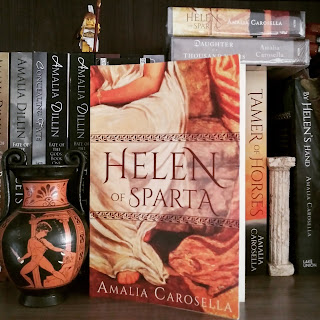
When you read the Lion of Troezen or Tamer of Horses, Ariadne and the Beast or Helen of Sparta, and encounter the mythic figures of Aethra and Hippodamia and Antiope, Helen and Ariadne, women whose names have endured for literal millennia, does it not make more sense that the reason they were remembered (by so many, many, many men in order to reach us now in the present) might have been, in part, because they were exceptional?
For myself, I would rather err on the side of giving them too much power rather than too little or none. I would rather believe that exceptional women found ways to exercise their power, rather than be stifled and hidden away in a dark, interior room, only allowed out in answer to their father or their husband's summons, meant neither to be seen OR heard.
There are such tantalizing glimpses of bigger lives inside their own myths! Aethra advising her son, King Theseus of Athens, who listens to and acknowledges her wisdom. Helen standing openly upon the walls of Troy, accepted by Priam as an authority on the Achaean Kings, battling below, and then later welcoming guests into her Spartan palace, presiding over them as the consummate hostess, having clearly taken charge of her husband and her home. Hippodamia, who was said to be kin to the Centaurs, an entirely different and decidedly UN-Greek society; Antiope, an Amazon queen--an even more foreign bride. And Ariadne. Ariadne who was so exceptional, so rare a woman, she was brought to Olympus and made a consort-wife to a god!
These were not meek women, eyes kept downcast, unable to exert any power or authority over their peoples or their lives. These mythic figures are opportunities to see how the women inside a patriarchal society might have MADE space for themselves, through sheer force of personality and will, through the power granted to them by birth or marriage, by the blessings of the very gods. Just like Medea or Circe, like the murderous Clytemnestra, just as women in history, like Hatshepsut and Cleopatra, Zenobia of Palmyra and Empress Aelia Pulcheria of the Eastern Roman Empire, and the Queens Victoria and Elizabeth of England did much, much, much later too.
When opportunities present themselves, even inside a strict patriarchy, people without power can and do find ways to claim it, particularly when they're born on its periphery or adjacent to the structure which grants it. And people have always been people, we know that. So there is no reason at all to think that these women, these mythic figures whose stories we love to tell and retell, couldn't have done so, too.


Amazon | Barnes&Noble | IndieBound


_-_Neptune_and_Caenis_-_RCIN_401218_-_Royal_Collection.jpg)